H2-air flame model#
The examples include a self-contained, pure-Python model of a two-dimensional premixed H2-air flame. It provides a moderately challenging benchmark for romtools workflows while requiring only NumPy and SciPy.
The core solver and romtools QoI wrapper live in examples/models. A quick
wrapper smoke test can be run from the repository root with
python examples/models/h2_air_flame_model.py
Problem definition#
The state contains hydrogen, oxygen, and water mass fractions together with a nondimensional temperature,
on a rectangular domain of size 1.8 cm by 0.9 cm. The semi-discrete model combines advection, diffusion, and an Arrhenius reaction source. A hot premixed inlet occupies the middle third of the left boundary, with ambient Dirichlet data above and below it and homogeneous-Neumann conditions on the remaining boundaries.
The four model parameters are
kappaDiffusivity.
scaled_activation_energyActivation energy divided by 1000. A representative value is 8.0, corresponding to an activation energy of 8000.
beta_xandbeta_yComponents of the advection velocity in cm/s.
beta_xis restricted to nonnegative values because the benchmark inlet and x-upwind stencil assume left-to-right flow.
A representative parameter vector is
The solver uses Crank-Nicolson time integration, central differences for
diffusion, a second-order backward upwind stencil in the x direction, and an
upwind stencil in the y direction. Newton systems are assembled as SciPy sparse
matrices. By default, each Newton system uses the exact assembled Jacobian and
is solved with GMRES, using one LU factorization of the fixed linear
Crank-Nicolson operator as a preconditioner for the whole transient solve. The
linear tolerance is tighter than the Newton tolerance; a GMRES solve that does
not meet its true residual tolerance automatically falls back to a direct
full-Jacobian solve. Set
linear_solver="direct" on H2AirFlame to use direct solves throughout.
Direct use#
The core solver is independent of romtools workflow interfaces. From
examples/models:
from h2_air_flame import H2AirFlame

model = H2AirFlame(
    nx=25,
    ny=13,
    dt=1.0e-4,
    t_end=5.0e-3,
    snapshot_stride=10,
)
states, times = model.solve(
    kappa=2.0,
    scaled_activation_energy=8.0,
    beta_x=40.0,
    beta_y=7.0,
)
states has shape (num_snapshots, 4, nx, ny). The temperature field is
stored as theta = T / 300 K so that the four state components remain on a
more useful scale for reduced-order modeling. Dimensional temperature is
therefore 300 * states[:, 3].
Default solution plot#
The figure below shows the final temperature field for the default lightweight configuration and the representative parameter vector
This corresponds to nx = 25, ny = 13, dt = 1e-4, and
t_end = 5e-3.
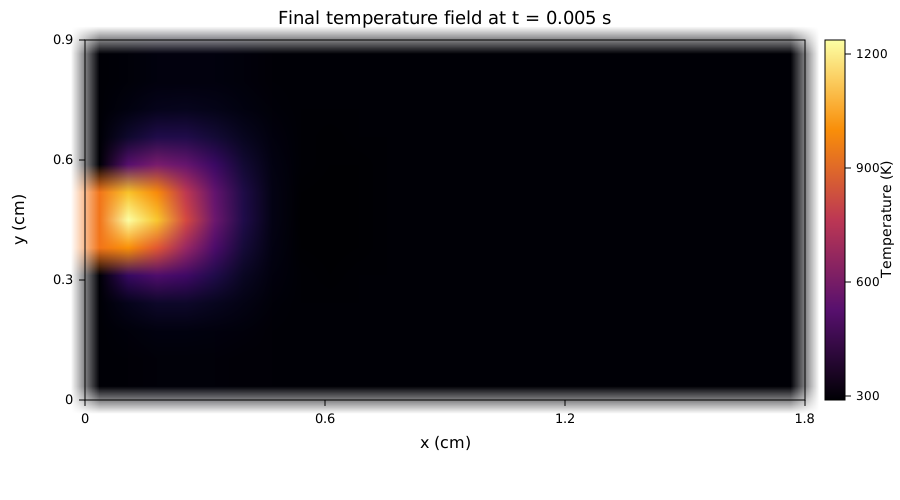
Final temperature field at t = 0.005 s for the default configuration.#
QoI model for romtools workflows#
H2AirFlameQoiModel provides the standard romtools model protocol. It uses
regularly strided temperature sensors as the QoI and writes both the QoI and
full state history to each run directory. Saving the state history allows the
same FOM evaluations to be reused later by state-based ROM builders.
from h2_air_flame_model import H2AirFlameQoiModel

qoi_model = H2AirFlameQoiModel(
    nx=25,
    ny=13,
    dt=1.0e-4,
    t_end=5.0e-3,
    snapshot_stride=10,
    spatial_sensor_stride=4,
)

sample = {
    "kappa": 2.0,
    "scaled_activation_energy": 8.0,
    "beta_x": 40.0,
    "beta_y": 7.0,
}

qoi_model.populate_run_directory("run_0", sample)
qoi_model.run_model("run_0", sample)
qoi = qoi_model.compute_qoi("run_0", sample)
This wrapper can be passed directly to romtools workflows that consume a QoI model.
Computational cost#
The default constructor values are intended to be lightweight enough for interactive experimentation. Increasing the spatial resolution or time horizon, or reducing the time step, increases the cost of the implicit nonlinear solve. Benchmark studies should therefore report model-evaluation counts together with wall-clock cost when comparing algorithms.
Implementation#
Core flame solver:
1"""Pure-Python two-dimensional premixed H2-air flame model.
2
3Solves a transient advection-diffusion-reaction system for H2, O2, H2O mass
4fractions and a nondimensional temperature using Crank-Nicolson time
5integration and Newton iterations.
6"""
7
8from typing import Tuple
9
10import numpy as np
11import scipy.sparse
12import scipy.sparse.linalg
13
14
15class H2AirFlame:
16 """Two-dimensional premixed H2-air advection-diffusion-reaction model.
17
18 The state ordering is ``[Y_H2, Y_O2, Y_H2O, theta]``, where
19 ``theta = T / temperature_scale``. The four model parameters are the
20 diffusivity ``kappa``, scaled activation energy ``E / 1000``, and the two
21 advection-velocity components ``beta_x`` and ``beta_y``.
22
23 Parameters
24 ----------
25 nx, ny:
26 Number of nodal points in the x and y directions, including boundary
27 points.
28 dt:
29 Time step in seconds.
30 t_end:
31 Final time in seconds. ``t_end / dt`` must be an integer.
32 snapshot_stride:
33 Number of time steps between stored snapshots. The initial and final
34 states are always stored.
35 newton_relative_tolerance, newton_absolute_tolerance:
36 Newton convergence tolerances for each implicit time step.
37 newton_max_iterations:
38 Maximum Newton iterations per time step.
39 linear_solver:
40 ``"gmres"`` uses the exact Newton Jacobian with restarted GMRES and a
41 single LU factorization of the fixed linear Crank--Nicolson operator as
42 a preconditioner. ``"direct"`` factors the full Newton Jacobian at
43 every Newton iteration.
44 gmres_relative_tolerance, gmres_absolute_tolerance:
45 Linear-solve tolerances used by the GMRES path. They should be tighter
46 than the Newton tolerance so that inexact linear solves do not limit
47 nonlinear convergence.
48 """
49
50 field_names = ("Y_H2", "Y_O2", "Y_H2O", "theta")
51 parameter_names = ("kappa", "scaled_activation_energy", "beta_x", "beta_y")
52
53 def __init__(
54 self,
55 nx: int = 25,
56 ny: int = 13,
57 dt: float = 1.0e-4,
58 t_end: float = 5.0e-3,
59 snapshot_stride: int = 10,
60 newton_relative_tolerance: float = 1.0e-6,
61 newton_absolute_tolerance: float = 1.0e-10,
62 newton_max_iterations: int = 80,
63 linear_solver: str = "gmres",
64 gmres_relative_tolerance: float = 1.0e-10,
65 gmres_absolute_tolerance: float = 0.0,
66 gmres_restart: int = 30,
67 gmres_max_iterations: int = 100,
68 ) -> None:
69 if nx < 4:
70 raise ValueError("nx must be at least 4 for the x-upwind stencil")
71 if ny < 3:
72 raise ValueError("ny must be at least 3")
73 if dt <= 0.0:
74 raise ValueError("dt must be positive")
75 if t_end <= 0.0:
76 raise ValueError("t_end must be positive")
77 if snapshot_stride < 1:
78 raise ValueError("snapshot_stride must be at least 1")
79 if newton_relative_tolerance <= 0.0 or newton_absolute_tolerance < 0.0:
80 raise ValueError(
81 "Newton tolerances must be nonnegative and rtol must be positive"
82 )
83 if newton_max_iterations < 1:
84 raise ValueError("newton_max_iterations must be at least 1")
85 if linear_solver not in ("gmres", "direct"):
86 raise ValueError("linear_solver must be 'gmres' or 'direct'")
87 if (
88 gmres_relative_tolerance <= 0.0
89 or gmres_absolute_tolerance < 0.0
90 ):
91 raise ValueError("GMRES tolerances must be nonnegative and rtol positive")
92 if gmres_restart < 1 or gmres_max_iterations < 1:
93 raise ValueError("GMRES iteration limits must be at least 1")
94
95 n_steps_float = t_end / dt
96 n_steps = int(round(n_steps_float))
97 if not np.isclose(n_steps_float, n_steps, rtol=0.0, atol=1.0e-12):
98 raise ValueError("t_end must be an integer multiple of dt")
99
100 self.nx = int(nx)
101 self.ny = int(ny)
102 self.dt = float(dt)
103 self.t_end = float(t_end)
104 self.snapshot_stride = int(snapshot_stride)
105 self.newton_relative_tolerance = float(newton_relative_tolerance)
106 self.newton_absolute_tolerance = float(newton_absolute_tolerance)
107 self.newton_max_iterations = int(newton_max_iterations)
108 self.linear_solver = linear_solver
109 self.gmres_relative_tolerance = float(gmres_relative_tolerance)
110 self.gmres_absolute_tolerance = float(gmres_absolute_tolerance)
111 self.gmres_restart = int(gmres_restart)
112 self.gmres_max_iterations = int(gmres_max_iterations)
113 self.linear_solver_stats = {}
114 self.num_steps = n_steps
115
116 self.length_x = 1.8 # cm
117 self.length_y = 0.9 # cm
118 self.x = np.linspace(0.0, self.length_x, self.nx)
119 self.y = np.linspace(0.0, self.length_y, self.ny)
120 self.dx = self.x[1] - self.x[0]
121 self.dy = self.y[1] - self.y[0]
122
123 self.temperature_scale = 300.0 # K
124 self.reaction_prefactor = 4.464956898694298e12
125 self.molecular_weights = np.array([2.016, 31.9, 18.0]) # g/mol
126 self.density = 1.39e-3 # g/cm^3
127 self.heat_of_reaction_scaled = 9800.0 / self.temperature_scale
128 self.gas_constant_times_temperature_scale = 8.314472 * self.temperature_scale
129 self.stoichiometric_coefficients = np.array([2.0, 1.0, -2.0])
130
131 self.ambient_temperature = 300.0
132 self.inlet_temperature = 950.0
133 self.inlet_h2_mass_fraction = 0.0282
134 self.inlet_o2_mass_fraction = 0.2259
135 self.inlet_h2o_mass_fraction = 0.0
136
137 self._gamma_1 = self.y >= 0.6
138 self._gamma_2 = np.logical_and(self.y > 0.3, self.y < 0.6)
139 self._gamma_3 = self.y <= 0.3
140 self._reaction_mask = np.ones((self.nx, self.ny))
141 self._reaction_mask[0, :] = 0.0
142 self._reaction_mask[-1, :] = 0.0
143 self._reaction_mask[:, 0] = 0.0
144 self._reaction_mask[:, -1] = 0.0
145
146 def initial_state(self) -> np.ndarray:
147 """Return the initial state with boundary conditions applied."""
148 state = np.zeros((4, self.nx, self.ny))
149 state[3, :, :] = self.ambient_temperature / self.temperature_scale
150 return self.apply_boundary_conditions(state)
151
152 def apply_boundary_conditions(self, state: np.ndarray) -> np.ndarray:
153 """Apply Dirichlet inlet and homogeneous-Neumann outlet/wall conditions."""
154 if state.shape != (4, self.nx, self.ny):
155 raise ValueError(
156 "state must have shape (4, nx, ny); got {}".format(state.shape)
157 )
158
159 state[:, :, 0] = state[:, :, 1]
160 state[:, :, -1] = state[:, :, -2]
161 state[:, -1, :] = state[:, -2, :]
162
163 state[0, 0, self._gamma_1] = 0.0
164 state[1, 0, self._gamma_1] = 0.0
165 state[2, 0, self._gamma_1] = 0.0
166 state[3, 0, self._gamma_1] = self.ambient_temperature / self.temperature_scale
167
168 state[0, 0, self._gamma_2] = self.inlet_h2_mass_fraction
169 state[1, 0, self._gamma_2] = self.inlet_o2_mass_fraction
170 state[2, 0, self._gamma_2] = self.inlet_h2o_mass_fraction
171 state[3, 0, self._gamma_2] = self.inlet_temperature / self.temperature_scale
172
173 state[0, 0, self._gamma_3] = 0.0
174 state[1, 0, self._gamma_3] = 0.0
175 state[2, 0, self._gamma_3] = 0.0
176 state[3, 0, self._gamma_3] = self.ambient_temperature / self.temperature_scale
177 return state
178
179 def _validate_parameters(
180 self,
181 kappa: float,
182 scaled_activation_energy: float,
183 beta_x: float,
184 beta_y: float,
185 ) -> Tuple[float, float, float, float]:
186 values = np.asarray(
187 [kappa, scaled_activation_energy, beta_x, beta_y], dtype=float
188 )
189 if not np.all(np.isfinite(values)):
190 raise ValueError("model parameters must be finite")
191 if kappa <= 0.0:
192 raise ValueError("kappa must be positive")
193 if scaled_activation_energy <= 0.0:
194 raise ValueError("scaled_activation_energy must be positive")
195 if beta_x < 0.0:
196 raise ValueError(
197 "beta_x must be nonnegative because the inlet and x-upwind stencil "
198 "assume left-to-right flow"
199 )
200 return tuple(float(value) for value in values)
201
202 @staticmethod
203 def _laplacian(state: np.ndarray, dx: float, dy: float) -> np.ndarray:
204 result = np.zeros_like(state)
205 result[:, 1:-1, :] += (
206 state[:, 2:, :] - 2.0 * state[:, 1:-1, :] + state[:, :-2, :]
207 ) / dx**2
208 result[:, :, 1:-1] += (
209 state[:, :, 2:] - 2.0 * state[:, :, 1:-1] + state[:, :, :-2]
210 ) / dy**2
211 return result
212
213 @staticmethod
214 def _x_upwind_derivative(state: np.ndarray, dx: float) -> np.ndarray:
215 result = np.zeros_like(state)
216 result[:, 1:, :] = (state[:, 1:, :] - state[:, :-1, :]) / dx
217 result[:, 2:, :] = (
218 1.5 * state[:, 2:, :]
219 - 2.0 * state[:, 1:-1, :]
220 + 0.5 * state[:, :-2, :]
221 ) / dx
222 return result
223
224 @staticmethod
225 def _y_upwind_derivative(
226 state: np.ndarray, dy: float, beta_y: float
227 ) -> np.ndarray:
228 result = np.zeros_like(state)
229 if beta_y >= 0.0:
230 result[:, :, 1:] = (state[:, :, 1:] - state[:, :, :-1]) / dy
231 else:
232 result[:, :, :-1] = (state[:, :, 1:] - state[:, :, :-1]) / dy
233 return result
234
235 def _linear_rhs(
236 self, state: np.ndarray, kappa: float, beta_x: float, beta_y: float
237 ) -> np.ndarray:
238 return (
239 kappa * self._laplacian(state, self.dx, self.dy)
240 - beta_x * self._x_upwind_derivative(state, self.dx)
241 - beta_y * self._y_upwind_derivative(state, self.dy, beta_y)
242 )
243
244 def _reaction_rhs(
245 self, state: np.ndarray, scaled_activation_energy: float
246 ) -> np.ndarray:
247 theta = state[3]
248 if np.any(theta <= 0.0):
249 raise FloatingPointError("temperature became nonpositive during the solve")
250
251 rho = self.density
252 weights = self.molecular_weights
253 activation_energy = scaled_activation_energy * 1.0e3
254 exponential = np.exp(
255 -activation_energy / (self.gas_constant_times_temperature_scale * theta)
256 )
257 h2_concentration = rho * state[0] / weights[0]
258 o2_concentration = rho * state[1] / weights[1]
259 rate = (
260 h2_concentration**2
261 * o2_concentration
262 * self.reaction_prefactor
263 * exponential
264 )
265
266 reaction = np.zeros_like(state)
267 for species in range(3):
268 reaction[species] = (
269 -self.stoichiometric_coefficients[species]
270 * (weights[species] / rho)
271 * rate
272 )
273 reaction[3] = reaction[2] * self.heat_of_reaction_scaled
274 return reaction
275
276 def rhs(
277 self,
278 state: np.ndarray,
279 kappa: float,
280 scaled_activation_energy: float,
281 beta_x: float,
282 beta_y: float,
283 ) -> np.ndarray:
284 """Evaluate the semi-discrete right-hand side."""
285 kappa, scaled_activation_energy, beta_x, beta_y = self._validate_parameters(
286 kappa, scaled_activation_energy, beta_x, beta_y
287 )
288 return self._linear_rhs(state, kappa, beta_x, beta_y) + self._reaction_rhs(
289 state, scaled_activation_energy
290 )
291
292 def _apply_boundary_conditions_to_residual(
293 self, state: np.ndarray, residual: np.ndarray
294 ) -> np.ndarray:
295 state_view = state.reshape((4, self.nx, self.ny))
296 residual_view = residual.reshape((4, self.nx, self.ny))
297
298 residual_view[:, :, 0] = state_view[:, :, 1] - state_view[:, :, 0]
299 residual_view[:, :, -1] = state_view[:, :, -1] - state_view[:, :, -2]
300 residual_view[:, -1, :] = state_view[:, -1, :] - state_view[:, -2, :]
301
302 residual_view[0, 0, self._gamma_1] = state_view[0, 0, self._gamma_1]
303 residual_view[1, 0, self._gamma_1] = state_view[1, 0, self._gamma_1]
304 residual_view[2, 0, self._gamma_1] = state_view[2, 0, self._gamma_1]
305 residual_view[3, 0, self._gamma_1] = (
306 state_view[3, 0, self._gamma_1]
307 - self.ambient_temperature / self.temperature_scale
308 )
309
310 residual_view[0, 0, self._gamma_2] = (
311 state_view[0, 0, self._gamma_2] - self.inlet_h2_mass_fraction
312 )
313 residual_view[1, 0, self._gamma_2] = (
314 state_view[1, 0, self._gamma_2] - self.inlet_o2_mass_fraction
315 )
316 residual_view[2, 0, self._gamma_2] = (
317 state_view[2, 0, self._gamma_2] - self.inlet_h2o_mass_fraction
318 )
319 residual_view[3, 0, self._gamma_2] = (
320 state_view[3, 0, self._gamma_2]
321 - self.inlet_temperature / self.temperature_scale
322 )
323
324 residual_view[0, 0, self._gamma_3] = state_view[0, 0, self._gamma_3]
325 residual_view[1, 0, self._gamma_3] = state_view[1, 0, self._gamma_3]
326 residual_view[2, 0, self._gamma_3] = state_view[2, 0, self._gamma_3]
327 residual_view[3, 0, self._gamma_3] = (
328 state_view[3, 0, self._gamma_3]
329 - self.ambient_temperature / self.temperature_scale
330 )
331 return residual_view.reshape(-1)
332
333 def _residual(
334 self,
335 next_state_flat: np.ndarray,
336 previous_state: np.ndarray,
337 previous_rhs: np.ndarray,
338 kappa: float,
339 scaled_activation_energy: float,
340 beta_x: float,
341 beta_y: float,
342 ) -> np.ndarray:
343 next_state = next_state_flat.reshape((4, self.nx, self.ny))
344 next_rhs = self._linear_rhs(
345 next_state, kappa, beta_x, beta_y
346 ) + self._reaction_rhs(next_state, scaled_activation_energy)
347 residual = (
348 next_state.reshape(-1)
349 - previous_state.reshape(-1)
350 - 0.5
351 * self.dt
352 * (next_rhs.reshape(-1) + previous_rhs.reshape(-1))
353 )
354 return self._apply_boundary_conditions_to_residual(next_state_flat, residual)
355
356 def _build_linear_residual_jacobian(
357 self, kappa: float, beta_x: float, beta_y: float
358 ) -> scipy.sparse.csr_matrix:
359 block_size = self.nx * self.ny
360 block = scipy.sparse.lil_matrix((block_size, block_size), dtype=float)
361 dx2_inv = 1.0 / self.dx**2
362 dy2_inv = 1.0 / self.dy**2
363 dx_inv = 1.0 / self.dx
364 dy_inv = 1.0 / self.dy
365
366 def index(i: int, j: int) -> int:
367 return i * self.ny + j
368
369 for i in range(self.nx):
370 for j in range(self.ny):
371 row = index(i, j)
372 if i == 0:
373 block[row, row] = 1.0
374 continue
375 if i == self.nx - 1:
376 block[row, row] = 1.0
377 block[row, index(i - 1, j)] = -1.0
378 continue
379 if j == 0:
380 block[row, row] = -1.0
381 block[row, index(i, j + 1)] = 1.0
382 continue
383 if j == self.ny - 1:
384 block[row, row] = 1.0
385 block[row, index(i, j - 1)] = -1.0
386 continue
387
388 diagonal = 1.0 + self.dt * kappa * (dx2_inv + dy2_inv)
389 x_im1 = -0.5 * self.dt * kappa * dx2_inv
390 x_im2 = 0.0
391 if i == 1:
392 diagonal += 0.5 * self.dt * beta_x * dx_inv
393 x_im1 -= 0.5 * self.dt * beta_x * dx_inv
394 else:
395 diagonal += 0.75 * self.dt * beta_x * dx_inv
396 x_im1 -= self.dt * beta_x * dx_inv
397 x_im2 = 0.25 * self.dt * beta_x * dx_inv
398
399 if beta_y >= 0.0:
400 diagonal += 0.5 * self.dt * beta_y * dy_inv
401 y_jm1 = (
402 -0.5 * self.dt * kappa * dy2_inv
403 - 0.5 * self.dt * beta_y * dy_inv
404 )
405 y_jp1 = -0.5 * self.dt * kappa * dy2_inv
406 else:
407 diagonal -= 0.5 * self.dt * beta_y * dy_inv
408 y_jm1 = -0.5 * self.dt * kappa * dy2_inv
409 y_jp1 = (
410 -0.5 * self.dt * kappa * dy2_inv
411 + 0.5 * self.dt * beta_y * dy_inv
412 )
413
414 block[row, row] = diagonal
415 block[row, index(i + 1, j)] = -0.5 * self.dt * kappa * dx2_inv
416 block[row, index(i - 1, j)] = x_im1
417 block[row, index(i, j - 1)] = y_jm1
418 block[row, index(i, j + 1)] = y_jp1
419 if i >= 2:
420 block[row, index(i - 2, j)] = x_im2
421
422 return scipy.sparse.block_diag(
423 [block.tocsr() for _ in range(4)], format="csr"
424 )
425
426 def _reaction_jacobian(
427 self, state_flat: np.ndarray, scaled_activation_energy: float
428 ) -> scipy.sparse.csr_matrix:
429 state = state_flat.reshape((4, self.nx, self.ny))
430 theta = state[3]
431 if np.any(theta <= 0.0):
432 raise FloatingPointError("temperature became nonpositive during the solve")
433
434 rho = self.density
435 weights = self.molecular_weights
436 activation_energy = scaled_activation_energy * 1.0e3
437 exponential = np.exp(
438 -activation_energy / (self.gas_constant_times_temperature_scale * theta)
439 )
440 h2_concentration = rho * state[0] / weights[0]
441 o2_concentration = rho * state[1] / weights[1]
442
443 prefactor = self.reaction_prefactor * exponential
444 rate = h2_concentration**2 * o2_concentration * prefactor
445 d_rate_d_h2 = (
446 2.0
447 * (rho / weights[0])
448 * h2_concentration
449 * o2_concentration
450 * prefactor
451 )
452 d_rate_d_o2 = (rho / weights[1]) * h2_concentration**2 * prefactor
453 d_rate_d_theta = rate * activation_energy / (
454 self.gas_constant_times_temperature_scale * theta**2
455 )
456
457 d_rate_d_h2 *= self._reaction_mask
458 d_rate_d_o2 *= self._reaction_mask
459 d_rate_d_theta *= self._reaction_mask
460
461 block_size = self.nx * self.ny
462 local = np.arange(block_size, dtype=int)
463 rows = []
464 cols = []
465 data = []
466
467 for species in range(4):
468 if species < 3:
469 coefficient = (
470 -self.stoichiometric_coefficients[species]
471 * weights[species]
472 / rho
473 )
474 else:
475 coefficient = (
476 -self.stoichiometric_coefficients[2]
477 * weights[2]
478 / rho
479 * self.heat_of_reaction_scaled
480 )
481
482 row = species * block_size + local
483 rows.extend([row, row, row])
484 cols.extend(
485 [
486 0 * block_size + local,
487 1 * block_size + local,
488 3 * block_size + local,
489 ]
490 )
491 data.extend(
492 [
493 coefficient * d_rate_d_h2.reshape(-1),
494 coefficient * d_rate_d_o2.reshape(-1),
495 coefficient * d_rate_d_theta.reshape(-1),
496 ]
497 )
498
499 return scipy.sparse.csr_matrix(
500 (np.concatenate(data), (np.concatenate(rows), np.concatenate(cols))),
501 shape=(4 * block_size, 4 * block_size),
502 )
503
504 def _newton_solve(
505 self,
506 previous_state: np.ndarray,
507 previous_rhs: np.ndarray,
508 linear_jacobian: scipy.sparse.csr_matrix,
509 kappa: float,
510 scaled_activation_energy: float,
511 beta_x: float,
512 beta_y: float,
513 linear_preconditioner=None,
514 ) -> np.ndarray:
515 iterate = previous_state.reshape(-1).copy()
516 residual = self._residual(
517 iterate,
518 previous_state,
519 previous_rhs,
520 kappa,
521 scaled_activation_energy,
522 beta_x,
523 beta_y,
524 )
525 initial_norm = np.linalg.norm(residual)
526 target = (
527 self.newton_absolute_tolerance
528 + self.newton_relative_tolerance * initial_norm
529 )
530 if initial_norm <= target:
531 return iterate.reshape(previous_state.shape)
532
533 for iteration in range(1, self.newton_max_iterations + 1):
534 reaction_jacobian = self._reaction_jacobian(
535 iterate, scaled_activation_energy
536 )
537 # Crank-Nicolson contributes one half of the new-state RHS Jacobian.
538 jacobian = linear_jacobian - 0.5 * self.dt * reaction_jacobian
539 update = self._solve_newton_linear_system(
540 jacobian, -residual, linear_preconditioner
541 )
542 if not np.all(np.isfinite(update)):
543 raise RuntimeError(
544 "Newton linear solve produced non-finite values at iteration {}".format(
545 iteration
546 )
547 )
548 iterate += update
549 residual = self._residual(
550 iterate,
551 previous_state,
552 previous_rhs,
553 kappa,
554 scaled_activation_energy,
555 beta_x,
556 beta_y,
557 )
558 residual_norm = np.linalg.norm(residual)
559 if not np.isfinite(residual_norm):
560 raise RuntimeError(
561 "Newton residual became non-finite at iteration {}".format(iteration)
562 )
563 if residual_norm <= target:
564 return iterate.reshape(previous_state.shape)
565
566 final_relative = np.linalg.norm(residual) / max(
567 initial_norm, np.finfo(float).tiny
568 )
569 raise RuntimeError(
570 "Newton solver failed to converge in {} iterations; "
571 "final relative residual={:.3e}".format(
572 self.newton_max_iterations, final_relative
573 )
574 )
575
576 def _solve_newton_linear_system(
577 self,
578 jacobian: scipy.sparse.csr_matrix,
579 right_hand_side: np.ndarray,
580 linear_preconditioner,
581 ) -> np.ndarray:
582 """Solve one exact Newton system, falling back to direct LU if needed."""
583 if linear_preconditioner is not None:
584 preconditioner = scipy.sparse.linalg.LinearOperator(
585 jacobian.shape,
586 matvec=linear_preconditioner.solve,
587 dtype=float,
588 )
589 callback_iterations = [0]
590 update, info = scipy.sparse.linalg.gmres(
591 jacobian,
592 right_hand_side,
593 M=preconditioner,
594 rtol=self.gmres_relative_tolerance,
595 atol=self.gmres_absolute_tolerance,
596 restart=self.gmres_restart,
597 maxiter=self.gmres_max_iterations,
598 callback=lambda _residual: callback_iterations.__setitem__(
599 0, callback_iterations[0] + 1
600 ),
601 callback_type="pr_norm",
602 )
603 self.linear_solver_stats["gmres_iterations"] += callback_iterations[0]
604 linear_residual = np.linalg.norm(jacobian @ update - right_hand_side)
605 linear_target = max(
606 self.gmres_absolute_tolerance,
607 self.gmres_relative_tolerance * np.linalg.norm(right_hand_side),
608 )
609 if (
610 info == 0
611 and np.all(np.isfinite(update))
612 and linear_residual <= linear_target
613 ):
614 return update
615 self.linear_solver_stats["gmres_direct_fallbacks"] += 1
616
617 self.linear_solver_stats["direct_solves"] += 1
618 return scipy.sparse.linalg.spsolve(
619 jacobian,
620 right_hand_side,
621 permc_spec="MMD_AT_PLUS_A",
622 use_umfpack=False,
623 )
624
625 def solve(
626 self,
627 kappa: float,
628 scaled_activation_energy: float,
629 beta_x: float,
630 beta_y: float,
631 ) -> Tuple[np.ndarray, np.ndarray]:
632 """Integrate the flame model and return ``(states, times)``.
633
634 ``states`` has shape ``(num_snapshots, 4, nx, ny)``. The temperature
635 component is nondimensional; multiply ``states[:, 3]`` by
636 :attr:`temperature_scale` to obtain kelvin.
637 """
638 kappa, scaled_activation_energy, beta_x, beta_y = self._validate_parameters(
639 kappa, scaled_activation_energy, beta_x, beta_y
640 )
641 linear_jacobian = self._build_linear_residual_jacobian(
642 kappa, beta_x, beta_y
643 )
644 self.linear_solver_stats = {
645 "gmres_iterations": 0,
646 "gmres_direct_fallbacks": 0,
647 "direct_solves": 0,
648 }
649 linear_preconditioner = None
650 if self.linear_solver == "gmres":
651 linear_preconditioner = scipy.sparse.linalg.splu(
652 linear_jacobian.tocsc(), permc_spec="MMD_AT_PLUS_A"
653 )
654
655 state = self.initial_state()
656 states = [state.copy()]
657 times = [0.0]
658
659 for step in range(1, self.num_steps + 1):
660 previous_state = state.copy()
661 previous_rhs = self._linear_rhs(
662 previous_state, kappa, beta_x, beta_y
663 ) + self._reaction_rhs(previous_state, scaled_activation_energy)
664 state = self._newton_solve(
665 previous_state,
666 previous_rhs,
667 linear_jacobian,
668 kappa,
669 scaled_activation_energy,
670 beta_x,
671 beta_y,
672 linear_preconditioner,
673 )
674 if step % self.snapshot_stride == 0 or step == self.num_steps:
675 states.append(state.copy())
676 times.append(step * self.dt)
677
678 return np.stack(states, axis=0), np.asarray(times)
679
680
681def extract_temperature_sensors(
682 states: np.ndarray,
683 spatial_stride: int = 4,
684 temporal_stride: int = 1,
685 temperature_scale: float = 1.0,
686) -> np.ndarray:
687 """Extract a flattened temperature-sensor QoI from a state history.
688
689 Parameters
690 ----------
691 states:
692 State history with shape ``(num_snapshots, 4, nx, ny)``.
693 spatial_stride:
694 Sample every ``spatial_stride`` grid points in each spatial direction.
695 temporal_stride:
696 Sample every ``temporal_stride`` stored snapshots.
697 temperature_scale:
698 Optional multiplicative scale. Use ``300.0`` to convert the default
699 nondimensional temperature to kelvin.
700 """
701 states = np.asarray(states)
702 if states.ndim != 4 or states.shape[1] != 4:
703 raise ValueError("states must have shape (num_snapshots, 4, nx, ny)")
704 if spatial_stride < 1 or temporal_stride < 1:
705 raise ValueError("sensor strides must be at least 1")
706 if not np.isfinite(temperature_scale) or temperature_scale <= 0.0:
707 raise ValueError("temperature_scale must be finite and positive")
708
709 temperature = states[
710 ::temporal_stride, 3, ::spatial_stride, ::spatial_stride
711 ]
712 return (temperature_scale * temperature).reshape(-1)
romtools QoI wrapper:
 1"""romtools QoI-model wrapper for the pure-Python H2-air flame benchmark."""
 2
 3import os
 4from typing import Dict
 5
 6import numpy as np
 7
 8from h2_air_flame import H2AirFlame, extract_temperature_sensors
 9
10
11class H2AirFlameQoiModel:
12    """Sensor-based ``QoiModel`` wrapper around :class:`H2AirFlame`.
13
14    The QoI consists of nondimensional temperature samples on regular spatial
15    and temporal strides. Full state histories are saved to each run directory
16    so the same FOM evaluations can also be reused for ROM construction.
17    """
18
19    parameter_names = H2AirFlame.parameter_names
20
21    def __init__(
22        self,
23        nx: int = 25,
24        ny: int = 13,
25        dt: float = 1.0e-4,
26        t_end: float = 5.0e-3,
27        snapshot_stride: int = 10,
28        spatial_sensor_stride: int = 4,
29        temporal_sensor_stride: int = 1,
30    ) -> None:
31        self._model_kwargs = {
32            "nx": nx,
33            "ny": ny,
34            "dt": dt,
35            "t_end": t_end,
36            "snapshot_stride": snapshot_stride,
37        }
38        self.spatial_sensor_stride = int(spatial_sensor_stride)
39        self.temporal_sensor_stride = int(temporal_sensor_stride)
40        if self.spatial_sensor_stride < 1 or self.temporal_sensor_stride < 1:
41            raise ValueError("sensor strides must be at least 1")
42
43    def populate_run_directory(self, run_directory: str, parameter_sample: Dict) -> None:
44        """Create the run directory required by the workflow model protocol."""
45        del parameter_sample
46        os.makedirs(run_directory, exist_ok=True)
47
48    def _parameters(self, parameter_sample: Dict):
49        missing = [name for name in self.parameter_names if name not in parameter_sample]
50        if missing:
51            raise KeyError(
52                "parameter_sample is missing required keys: {}".format(missing)
53            )
54        return [float(parameter_sample[name]) for name in self.parameter_names]
55
56    def run_model(self, run_directory: str, parameter_sample: Dict) -> int:
57        """Run the flame model and save states, times, parameters, and QoI."""
58        model = H2AirFlame(**self._model_kwargs)
59        parameters = self._parameters(parameter_sample)
60        states, times = model.solve(*parameters)
61        qoi = extract_temperature_sensors(
62            states,
63            spatial_stride=self.spatial_sensor_stride,
64            temporal_stride=self.temporal_sensor_stride,
65        )
66        np.savez(
67            os.path.join(run_directory, "solution.npz"),
68            states=states,
69            times=times,
70            qoi=qoi,
71            parameter_names=np.asarray(self.parameter_names),
72            parameters=np.asarray(parameters),
73        )
74        return 0
75
76    def compute_qoi(self, run_directory: str, parameter_sample: Dict) -> np.ndarray:
77        """Read and return the flattened temperature-sensor QoI."""
78        del parameter_sample
79        with np.load(os.path.join(run_directory, "solution.npz")) as data:
80            return np.asarray(data["qoi"], dtype=float)
81
82
83if __name__ == "__main__":
84    import tempfile
85
86    sample = {
87        "kappa": 2.0,
88        "scaled_activation_energy": 8.0,
89        "beta_x": 40.0,
90        "beta_y": 7.0,
91    }
92    with tempfile.TemporaryDirectory() as directory:
93        model = H2AirFlameQoiModel(
94            nx=12, ny=7, t_end=2.0e-4, snapshot_stride=1
95        )
96        model.populate_run_directory(directory, sample)
97        model.run_model(directory, sample)
98        qoi = model.compute_qoi(directory, sample)
99        print("H2-air flame QoI size:", qoi.size)